


Why Not The Stairs? — a behavioral design study on the gap between what people intend and what they do, one floor at a time.
4
Delight creates curiosity, but only feedback builds habits.
2
Measure behaviour beyond the intervention site.
Workarounds are valuable behavioural data.
3
The true comparison isn't stairs versus lift.
It's every available path of least resistance.
1
Remove friction everywhere the behaviour can hide.
The intervention improved behaviour locally but didn't change the wider environment.
The study distinguished between:
Real behaviour change
Behaviour relocation
Friction exists across the whole journey, not just one staircase.
Instead of climbing, many people walked to another building to use a different lift.
The habit didn't disappear.
It simply relocated.
The staircase wasn't competing against one lift.
It was competing against every convenient alternative.
What this changes about designing for behaviour
The stairwell was never the whole system.


What we expected
They didn't take the stairs. They left the building.


After Nudges
Before Nudges

Graphs compare lift and stair usage over three days.
Chose the lift.
chose the lift.
The gap closed, day over day

Observations:
Researchers tracked:
About half still used the lift.
Many people only chose the lift after encountering friction.
Most stair users followed the Pac-Man game.
Which route people chose
Whether they noticed the game
Whether they completed it
What three days on-site looked like
3. Pac-Man Stair Game
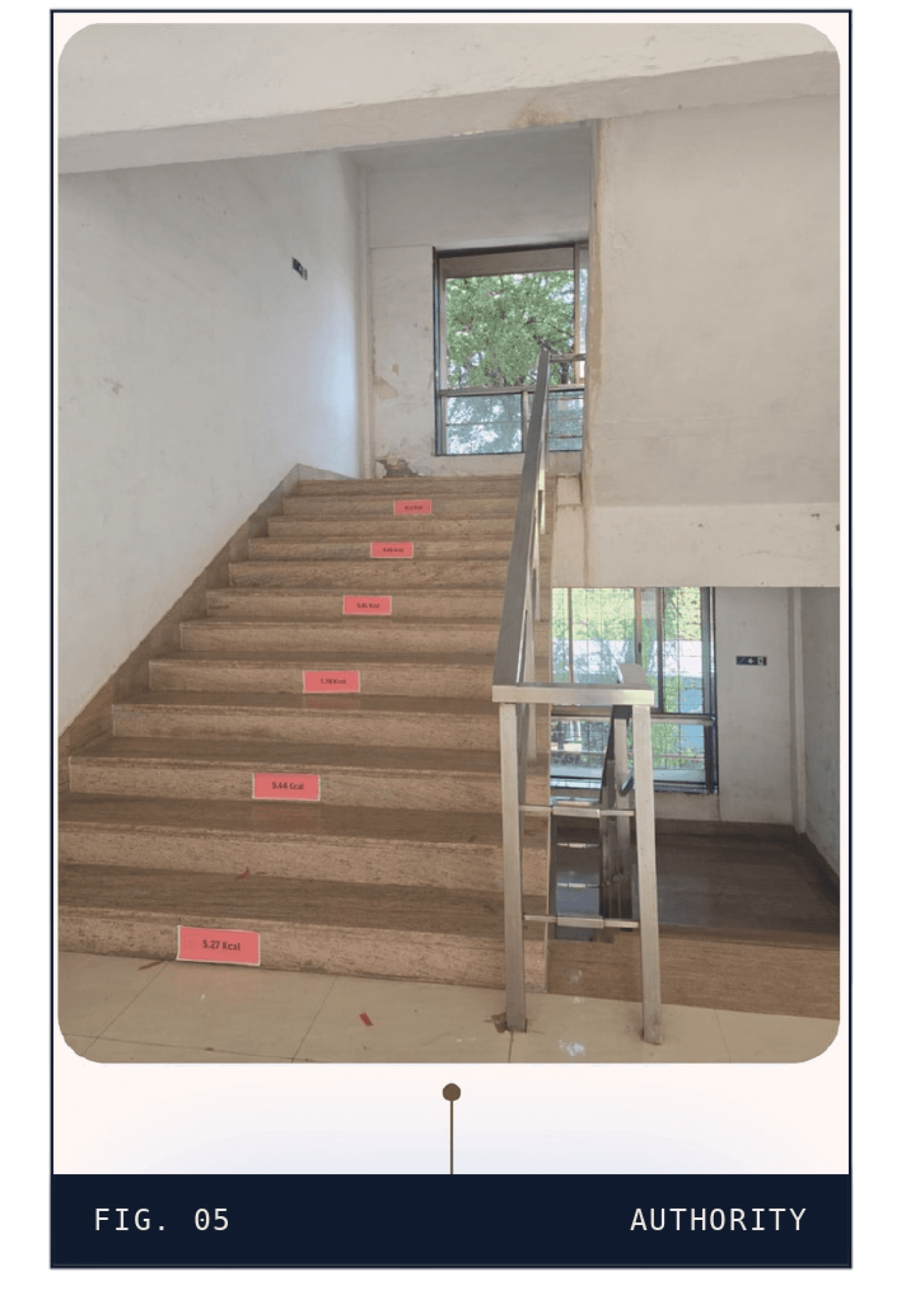
2. Calorie Stickers
1. Lift Restriction
A playful Pac-Man graphic covered the stairs.
Behaviour Principle: Liking
Turning the climb into an enjoyable activity.
Each step displayed calories burned.
Behaviour Principle: Authority
Making health benefits immediate and visible.
One lift was taken out of service.
Behaviour Principle: Scarcity
Removing the default option so stairs become the easier alternative.


Interventions
Add friction to using the lift
Reward the climb
Make stairs more visible
Three interventions were proposed:
If the stairwell could compete for attention, could it compete for behaviour?
The stairwell has one opportunity to convince someone to return.
2. One chance to convert
Without visible rewards or progress, new behaviour doesn't stick.
5. No feedback, no habit
Seeing someone use the stairs encourages others.
4. Behaviour is contagious
People choose what feels faster rather than what actually is.
3. Perceived, not measured
People try interventions because they're curious, not because they intend to change.
1. Novelty fades fast
Five things worth designing for


WHAT

HOW

WHERE
Mapping the exact moment of choice
Zero stimulus in stairwells
Perceived speed
Habit, not laziness
People consistently choose lifts over stairs for short distances (one to three floors), and the reasons have almost nothing to do with fitness or time.
Habit picks the lift before a decision is even made.
The stairwell is hidden, poorly lit, and offers nothing interesting on the way up.
The lift feels faster, even when it isn't.
The lift wins because it asks nothing from the user.
Convenience beats intention, every single time.
A question simple enough to ignore, and stubborn enough to survive every obvious fix aimed at it.
"Why not the stairs?"

Every building has this moment. A small crowd gathers at the lift lobby, waits, watches the floor indicator climb, and rides one storey up a distance that eleven steps would cover in less time than the doors take to close.
Nobody questions it. That silence was the real subject of this project not the stairs themselves, but the automatic, unexamined decision to avoid them.
The staircase sat a few metres away the entire time: dim, a little dusty, entirely ignored. It wasn't broken. It was simply never chosen.
Six people. One elevator. One floor.
GROUND 01 02 03 - THE FOUR FLOORS WHERE THIS PROJECT LIVED
Live Testing
Nudge Design
Behaviour Mapping
Field Research

A study of a single staircase, a single lift, and the automatic decision six hundred people make every day without noticing they've made it at all.
Why Not
The Stairs ?